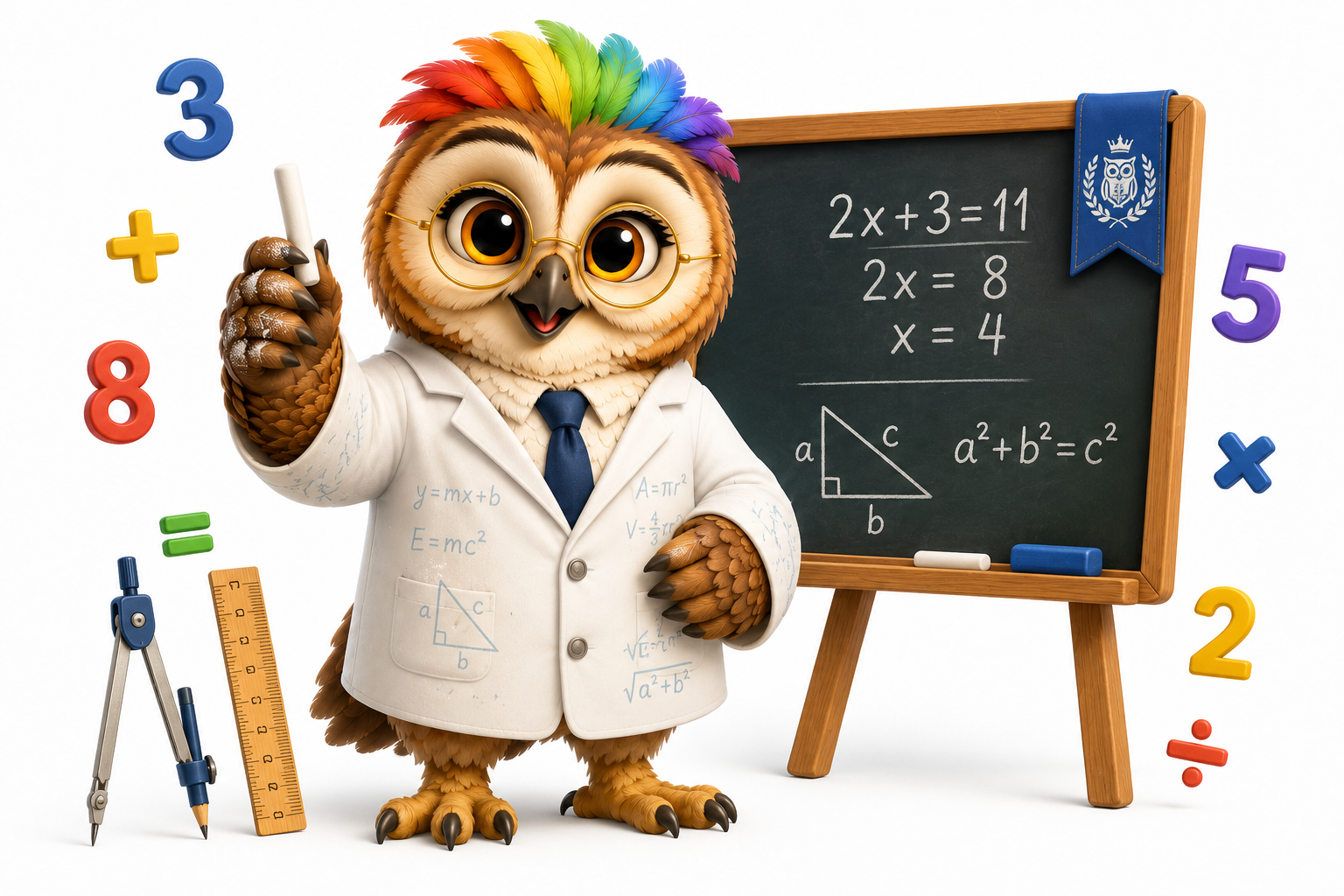
"Math is the language of the universe — and you're learning to speak it!"
Numbers are your superpower! Master math from counting to compound interest with games, puzzles, and real-world problems.
"Math is the language of the universe — and you're learning to speak it!"
Explore each topic — from basic operations to real-world money math!
Master the building blocks! Adding and subtracting numbers in everyday situations like shopping and counting.
Repeated addition made fast! Learn times tables and how multiplication applies to earning and budgeting.
Splitting fairly! Division helps with splitting bills, sharing pizza, and calculating unit prices at the store.
Parts of a whole! Fractions are everywhere — splitting food, measuring ingredients, and understanding percentages.
Percent means "per hundred." Sales discounts, interest rates, and tips are all expressed as percentages!
Shapes, area, perimeter, and volume! Used in architecture, art, and even building your dream room layout.
Solving for the unknown "x"! Algebra is the language of math and shows up in everything from coding to investing.
Reading data! Mean, median, mode, and charts help us understand the world and make smart decisions.
The math of money! Interest, taxes, ROI, and budgeting — math skills that directly impact your future wealth.
Math isn't just homework — it powers every career, technology, and discovery on Earth!
NASA engineers use calculus, trigonometry, and orbital mechanics to launch rockets to Mars. Every trajectory, fuel calculation, and landing burn is pure math!
Architects use geometry, algebra, and structural math to design buildings that stand up to wind, earthquakes, and gravity. The Burj Khalifa required millions of equations!
Doctors calculate drug doses using body weight and ratios. Medical imaging (MRI, CT scans) uses Fourier transforms — advanced math — to build pictures of your insides.
Every app, game, and website runs on algorithms — math logic. Machine learning and AI are entirely built on linear algebra, statistics, and calculus. Coding IS applied math!
Compound interest, risk models, and stock pricing all use exponential growth equations. Warren Buffett credits compound interest math as the foundation of his $100B+ fortune.
Sound waves are mathematics! Musical notes follow precise frequency ratios. Audio engineers use Fourier analysis to mix tracks, and rhythm is pure fraction and ratio work.
Solve the puzzle! Get it right and earn a star!
Watch your savings grow with the power of time and interest!
Never pay full price without knowing your savings first!
The greatest ideas in mathematical history — from ancient Greece to the 20th century. Click any theorem to expand it!
Proven by the ancient Greek mathematician Pythagoras (~500 BC), this theorem states that in any right triangle, the square of the longest side (hypotenuse, c) equals the sum of the squares of the other two sides.
It's used in architecture, navigation, engineering, physics, and computer graphics every single day. If your screen shows a diagonal line — Pythagoras made it work!
Discovered by Leonhard Euler in the 18th century, this equation is called "the most beautiful in mathematics" because it connects five of the most fundamental constants in all of math in a single elegant statement:
e (≈2.718) · the base of natural logarithms · i · the imaginary unit (√−1) · π (≈3.14159) · the ratio of a circle's circumference · 1 · the unit of counting · 0 · the concept of nothing
Each number in the Fibonacci sequence is the sum of the two before it (0+1=1, 1+1=2, 1+2=3, 2+3=5…). Introduced to Europe by Leonardo Fibonacci in 1202, this sequence appears everywhere in nature.
Divide any Fibonacci number by the one before it and you get approximately 1.618 — the Golden Ratio (φ). This proportion is found in the Parthenon, the Mona Lisa, spiral galaxies, hurricanes, and the human face.
Every whole number greater than 1 can be written as a unique product of prime numbers, in exactly one way. For example: 60 = 2 × 2 × 3 × 5. No matter how you break down 60, you always arrive at these same primes.
Prime numbers (2, 3, 5, 7, 11, 13…) are the "atoms" of mathematics — the indivisible building blocks from which all whole numbers are constructed. This theorem, known since ancient Greece, is why primes matter so profoundly.
In 1637, mathematician Pierre de Fermat wrote in a book margin: "I have a truly marvelous proof of this theorem, which this margin is too narrow to contain." His claim: there are no whole-number solutions to aⁿ + bⁿ = cⁿ when n is greater than 2.
Mathematicians tried for 358 years to prove it. Thousands failed. Finally in 1995, Andrew Wiles published a 130-page proof — after working in secret for 7 years. When he presented it, the mathematics community wept.
Georg Cantor proved in 1891 that there are different sizes of infinity — and some infinities are genuinely larger than others. The infinity of all real numbers (including decimals) is strictly bigger than the infinity of all whole numbers.
He showed this with a clever "diagonal argument" — you can always construct a real number that's missing from any list of real numbers, proving the list can never be complete no matter how long it is.
In 1742, Christian Goldbach wrote to Euler claiming every even number greater than 2 can be written as the sum of two prime numbers. For example: 4=2+2, 6=3+3, 8=3+5, 100=3+97, 1000=3+997.
It has been verified by computers for every even number up to 4 × 10¹⁸ (that's 4 quintillion!). But no one has ever proven it works for ALL even numbers. It remains one of the oldest unsolved problems in all of mathematics.
5 math challenges — how many can you get right?