๐Ÿ”ฌ

Science Wing

Put on your lab coat! Explore the universe from atoms to galaxies through fun experiments, discovery, and amazing facts.

๐Ÿงช Experiments ๐ŸŒŒ Space ๐ŸŽฎ Quiz
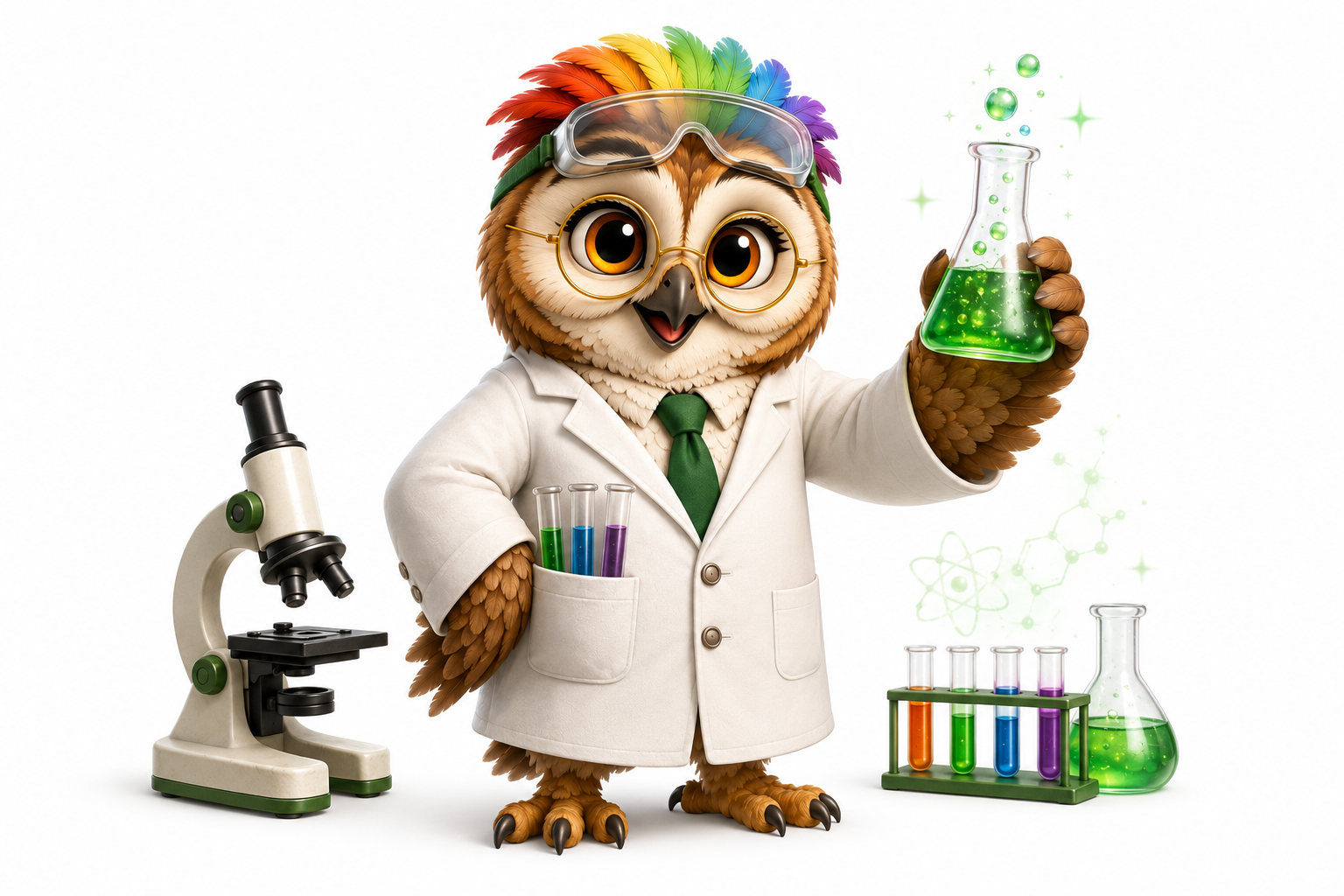
Professor Pop โ€” The Lab Experimenter

"Science is just asking 'why?' โ€” and then finding out!"

โ–ถ๏ธ Watch Science Wing Videos on YouTube โ†’

๐Ÿ”ญ Science Topics

Explore every corner of the natural world!

๐Ÿฆ‹
Beginner

Life Cycles

Discover how living things are born, grow, reproduce, and die. From caterpillar to butterfly โ€” the magic of metamorphosis!

๐Ÿ› A caterpillar completely dissolves its own body inside the chrysalis and rebuilds itself as a butterfly!
๐Ÿงฌ
Intermediate

Cells & DNA

Every living thing is made of cells! Learn about the building blocks of life and how DNA carries the instructions for everything you are.

๐Ÿ”ฌ Your body contains about 37 trillion cells. If you stretched out all your DNA, it would reach the Sun and back over 300 times!
๐ŸŒฑ
Beginner

Plants & Photosynthesis

Plants are solar-powered! They capture sunlight and turn it into food through photosynthesis, giving us oxygen as a bonus.

๐ŸŒฟ Formula: COโ‚‚ + Water + Sunlight โ†’ Glucose + Oxygen. Plants feed on sunlight!
๐ŸŒ‹
Intermediate

Volcanoes & Tectonic Plates

The Earth's surface is split into giant plates that move! When they collide or separate, we get earthquakes and volcanoes.

๐ŸŒ‹ Mount Everest grows about 5mm taller every year as the Indian plate pushes into Asia!
๐ŸŒก๏ธ
Intermediate

Climate & Weather

Weather is what happens today; climate is the pattern over decades. Learn the difference and why climate change matters.

๐ŸŒก๏ธ Earth's average temperature has risen 1.1ยฐC since the 1800s due to greenhouse gases. Small change, big impact!
๐Ÿ’ง
Beginner

The Water Cycle

Water evaporates, forms clouds, falls as rain, and flows back to the ocean โ€” a never-ending cycle that keeps our planet alive!

๐Ÿ’ง The water you drink today may have been drunk by a dinosaur millions of years ago!
โš›๏ธ
Intermediate

Atoms & Elements

Everything is made of tiny particles called atoms! The periodic table organizes all known elements โ€” 118 so far.

โš›๏ธ If an atom were the size of a football stadium, the nucleus would be a marble in the center. It's 99.9999% empty space!
๐Ÿงช
Beginner

Acids & Bases

Some substances are acids (sour, like lemon juice), others are bases (slippery, like soap). The pH scale measures 1โ€“14!

๐Ÿ‹ Lemon juice is pH 2 (very acidic). Bleach is pH 13 (very basic). Pure water is 7 (neutral).
๐Ÿ”ฅ
Advanced

Chemical Reactions

When substances react, new substances form! Learn about reactants, products, and why baking soda + vinegar fizzes so dramatically.

๐Ÿž Baking bread is chemistry! Yeast eats sugar and produces COโ‚‚ gas โ€” that's what makes bread rise and get fluffy.
๐ŸŽ
Beginner

Gravity & Forces

Gravity pulls everything toward each other. Newton discovered it when an apple fell โ€” but really, YOU pull the Earth too (just a tiny bit)!

๐ŸŒ™ On the Moon you'd weigh 1/6 your Earth weight! Gravity there is much weaker.
๐Ÿ’ก
Intermediate

Electricity & Circuits

Electrons flowing through wires create electricity. Learn how circuits work โ€” the same science in your phone and toaster!

โšก Lightning is static electricity โ€” up to 1 billion volts! It's 5x hotter than the sun's surface.
๐ŸŒŠ
Intermediate

Waves & Sound

Sound is vibrations moving through matter. Light is electromagnetic waves. Learn why the sky is blue and how music works!

๐ŸŽต Sound travels at ~343 meters/second in air. Light travels at 300 million meters/second โ€” about 874,000x faster!
๐Ÿซ€
Beginner

Circulatory System

Your heart beats ~100,000 times a day, pumping blood through 60,000 miles of blood vessels! Blood carries oxygen and nutrients to every cell in your body.

โค๏ธ Your heart is about the size of your fist. It pumps roughly 2,000 gallons of blood every single day!
๐Ÿง 
Advanced

Nervous System

Your brain has ~86 billion neurons and processes millions of signals per second. Nerve impulses travel at up to 250 mph โ€” faster than a race car!

โšก Your brain uses 20% of your body's energy even though it's only 2% of your body weight. Thinking is hard work!
๐Ÿฆด
Beginner

Skeletal System

You have 206 bones that protect your organs, help you move, and make blood cells in your bone marrow. Babies are born with ~270 bones โ€” some fuse as you grow!

๐Ÿ’ช The femur (thigh bone) is the strongest bone in your body โ€” stronger than concrete for its size!
๐Ÿซ
Intermediate

Respiratory System

You breathe around 22,000 times a day! Your lungs bring in oxygen and expel carbon dioxide. The surface area of your lungs spread flat would cover a tennis court.

๐ŸŒฌ๏ธ When you sneeze, air shoots out at up to 100 mph โ€” faster than a hurricane wind!
๐Ÿฝ๏ธ
Intermediate

Digestive System

Food travels 30 feet through your digestive system over 24โ€“72 hours! Your stomach acid is strong enough to dissolve metal โ€” but special mucus protects the stomach lining.

๐Ÿฆ  Your gut contains ~100 trillion bacteria โ€” more cells than the rest of your body! They help digest food and fight disease.
๐Ÿ”ฌ
Advanced

Immune System

Your immune system is an army of ~2 trillion cells that fight viruses, bacteria, and other invaders every second. Vaccines teach it to recognize enemies before they attack!

๐Ÿ›ก๏ธ White blood cells called neutrophils can destroy bacteria in under 60 seconds. Your body is fighting for you right now!

๐Ÿ”ฌ The Scientific Method

Every discovery in history followed these 6 steps โ€” from Newton's apple to the Moon landing!

1
Ask a Question

"Why does bread rise?" "How do birds navigate?" All great science starts with curiosity and a good question.

โ†“
2
Do Background Research

Read what others have already discovered. Good scientists build on existing knowledge โ€” no need to reinvent the wheel!

โ†“
3
Form a Hypothesis

Make an educated, testable guess: "If I add more sugar, the reaction will be faster because sugar is fuel for yeast." Must be falsifiable!

โ†“
4
Experiment & Collect Data

Test your hypothesis โ€” change only ONE variable at a time. Write down EVERYTHING you observe, even the surprises.

โ†“
5
Analyze Your Results

Look at your data. Make graphs and tables. Did results match your hypothesis, or did something unexpected happen? Both are valuable!

โ†“
6
Draw Conclusions & Share

Was your hypothesis supported? What did you learn? Share your findings โ€” that's how science grows and the world improves!

๐Ÿฆ‰ Pop's Reminder: A "failed" experiment that disproves your hypothesis is still great science! Einstein said "I have not failed โ€” I've found 10,000 ways that won't work."

๐Ÿงช At-Home Experiments

Safe, fun experiments you can do at home with everyday items!

๐ŸŒ‹
Easy

Baking Soda Volcano

Create an erupting volcano with kitchen ingredients! Learn about acid-base reactions.

Supplies: baking soda, vinegar, dish soap

๐ŸŒˆ
Easy

Skittles Rainbow

Create a stunning rainbow using Skittles candy and warm water. Pure science magic!

Supplies: Skittles, warm water, white plate

๐ŸŒฑ
Medium

Grow a Plant in a Bag

Watch germination happen in real-time in a clear zip bag taped to your window!

Supplies: zip bag, bean seeds, paper towel, water

๐Ÿ† Famous Scientists

These brilliant minds changed everything we know about the universe โ€” click each card to flip it and learn their story!

๐ŸŽ
Isaac Newton
1643โ€“1727 ยท England
Tap to learn โ†’
Discovered: Laws of Motion & Gravity

When an apple fell nearby, Newton derived the mathematical laws governing every object in the universe. His Principia Mathematica powered the Space Age 300 years later. He also invented calculus!
โšก
Albert Einstein
1879โ€“1955 ยท Germany
Tap to learn โ†’
Discovered: Theory of Relativity (E=mcยฒ)

Einstein proved that energy and mass are the same thing (E=mcยฒ), that space and time are one fabric, and that gravity bends light. His ideas made GPS satellites, nuclear energy, and black hole science possible.
๐Ÿงฌ
Rosalind Franklin
1920โ€“1958 ยท England
Tap to learn โ†’
Discovered: Structure of DNA

Franklin's X-ray photograph of DNA (Photo 51) revealed DNA's double helix shape โ€” the most important image in biology. Without her work there would be no modern genetics, medicine, or genetic research.
๐Ÿข
Charles Darwin
1809โ€“1882 ยท England
Tap to learn โ†’
Discovered: Theory of Evolution by Natural Selection

After 5 years sailing the world studying animals, Darwin showed that all life on Earth evolved from common ancestors through natural selection. His On the Origin of Species (1859) remains one of the most important books ever written.
๐ŸŒŒ
Stephen Hawking
1942โ€“2018 ยท England
Tap to learn โ†’
Discovered: Hawking Radiation & Black Hole Theory

Paralyzed from ALS but with one of history's greatest minds, Hawking proved black holes emit radiation and linked quantum mechanics to general relativity. He communicated entirely through a speech device โ€” and still wrote bestselling books!
๐Ÿ’ก
Nikola Tesla
1856โ€“1943 ยท Serbia/USA
Tap to learn โ†’
Invented: AC Electricity, Radio, & More

Tesla invented the alternating current (AC) electrical system that powers virtually every building on Earth today. He also pioneered radio, X-rays, and wireless transmission. He held over 300 patents and his name now powers electric cars!

๐ŸŒŒ Solar System Explorer

Click each planet to learn amazing facts!

๐ŸŸค
Mercury
1st from Sun
๐ŸŸก
Venus
2nd from Sun
๐ŸŒ
Earth
3rd from Sun
๐Ÿ”ด
Mars
4th from Sun
๐ŸŸ 
Jupiter
5th from Sun
๐Ÿช
Saturn
6th from Sun
๐Ÿ”ต
Uranus
7th from Sun
๐Ÿ’™
Neptune
8th from Sun

๐ŸŽฎ Science Quiz!

Test your scientific knowledge! 5 questions await.